
AI Interview Coach: What It Is, How It Works, and Why It Beats Solo Practice

Melo Colon
11-Jun-2026
You can read every interview guide on the internet, rehearse in front of a mirror, and still freeze when a recruiter says, “Tell me about a time you failed.”
That gap between knowing the answer and delivering the answer is exactly where most candidates lose offers. An AI interview coach is built to close it.
This guide breaks down what an AI interview coach actually is, how an AI video interviewer works behind the scenes, and why structured AI interview preparation consistently outperforms practicing alone. You will also get a 7-day prep plan, a realistic comparison table, and an answer to every common question candidates ask before signing up for free mock interview practice.
What Is an AI Interview Coach?
An AI interview coach is a software platform that simulates a real job interview, evaluates your answers in real time, and gives you structured feedback you can act on before the next round.
The strongest tools combine four things in one place:
- A lifelike AI video interviewer that asks role-specific questions
- Speech and language analysis that scores clarity, pacing, and content
- Coaching feedback tied to proven frameworks like the STAR method
- A progress dashboard so you can see what is actually getting better
Think of it as a flight simulator for interviews. You get the pressure, the realism, and the replay value, without burning a real opportunity to figure out you say “um” 14 times per minute.
Most AI interview coaches now run inside the browser, work on any laptop with a webcam, and offer some form of free AI interview practice so you can test the experience before paying for anything.
How an AI Video Interviewer Actually Works
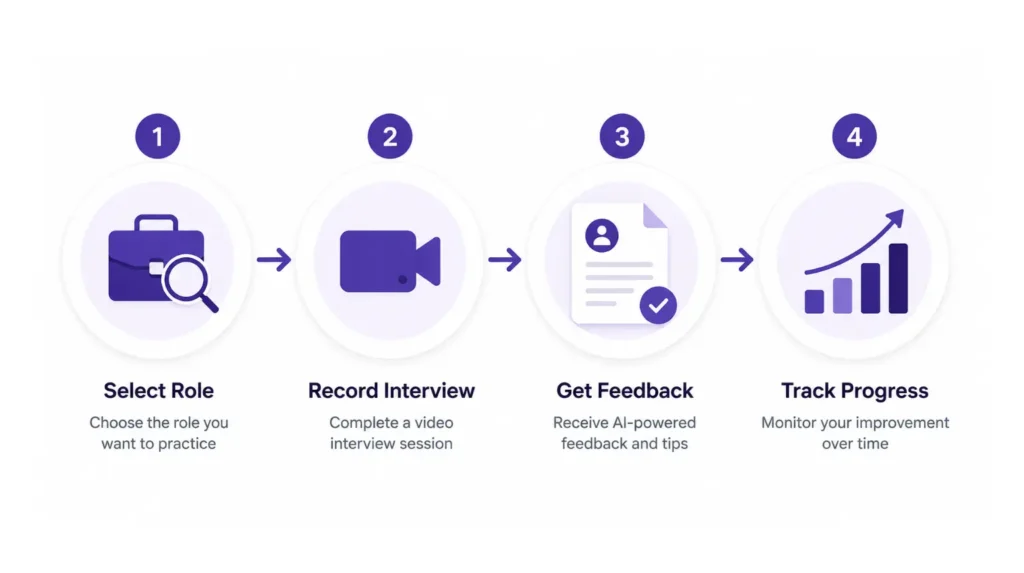
An AI video interviewing tool is not just a chatbot with a webcam. It is a layered system that mimics how human recruiters evaluate candidates, then adds analysis humans cannot do in real time.
Here is the typical flow.
Step 1: Pick a role, company, or job description
You tell the platform what you are preparing for. That can be a specific role like “Senior Product Manager,” a target company like Google or Stripe, or a pasted job description.
The AI uses that input to pull from a question bank built around real hiring patterns. A senior engineer practicing for Amazon gets different questions than a marketing manager interviewing at a Series B startup, and the difficulty scales with seniority.
Step 2: Sit through a realistic AI video interview
This is where AI video interviewing earns the name. A virtual interviewer appears on screen, asks a question out loud, and waits for your answer on camera. You speak naturally, just like a Zoom interview, while the system captures audio and video.
There are no scripts to read, no chat boxes to type into, and no friendly nodding to fool yourself into thinking you nailed it. The pressure is intentional. That is what makes the practice transfer to the real thing.
Step 3: Receive instant, structured feedback
After each answer, or at the end of the session, the AI returns a breakdown that usually covers:
- Content quality: Did you actually answer the question with relevant detail
- Structure: Did your answer follow a clear arc, often the STAR method for behavioral questions
- Clarity and confidence: How easy were you to follow, how decisive did you sound
- Speaking pace and filler words: Are you racing through, dragging, or peppering answers with “like” and “um”
A good AI interview coach does not just grade. It rewrites weak sections, suggests sharper phrasing, and tells you exactly what to try in your next attempt.
Step 4: Track progress and repeat with sharper answers
The session is logged to a progress dashboard. Over multiple practices, you can see filler words drop, clarity scores rise, and weak answer patterns get cleaner. That feedback loop is what turns nervous candidates into calm, prepared ones.
Featured snippet style answer: An AI video interviewer asks job-specific questions on camera, records your spoken answers, and uses speech and language analysis to evaluate content, structure, clarity, pacing, and confidence in real time.
Solo Practice vs AI Interview Practice: An Honest Comparison
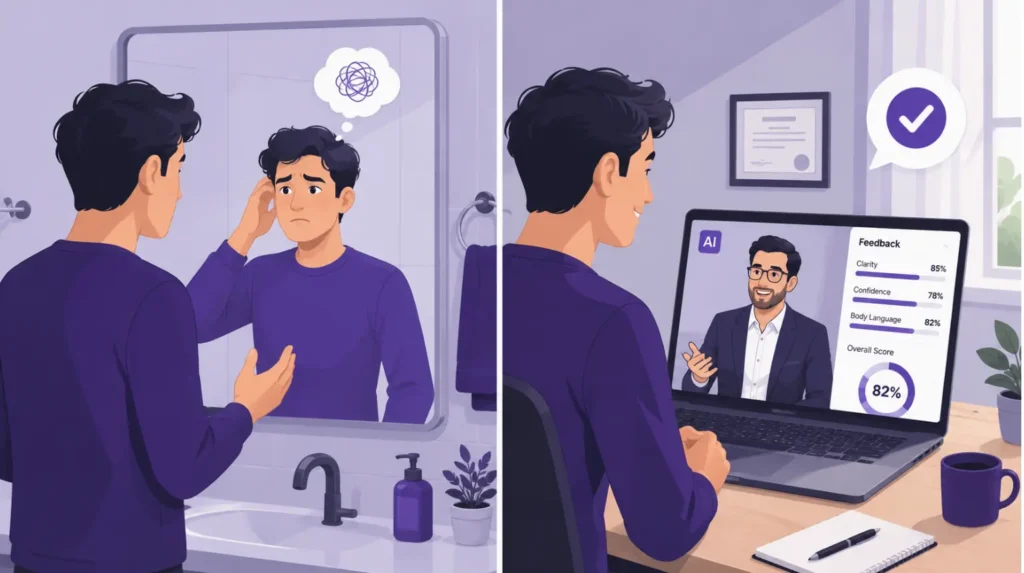
Solo practice is not useless. It is just incomplete. Here is a side-by-side look.
| Element | Solo Practice | AI Interview Practice |
|---|---|---|
| Realistic question variety | Limited to what you can think of | Thousands of role-specific questions |
| Live pressure | Almost none | Camera-on, time-bound, recorded |
| Objective feedback | None | Scored content, pacing, filler words, clarity |
| STAR structure coaching | Self-judged | AI rewrites and refines your STAR stories |
| Speech analysis | Your guess | Measured pace, tone, and word choice |
| Progress tracking | Vibes | Dashboards and trend lines |
| Availability | When you feel like it | 24/7, no scheduling, no awkward favors |
| Cost | Free | Free mock interview practice plus paid tiers |
Solo practice is great for memorizing facts about a company or polishing your elevator pitch. It is not great at telling you the truth about how you sound under pressure. That is where AI interview prep takes over.
Why AI Video Interviewing Beats the Mirror, the Notes App, and the Friend Mock
Three common DIY approaches all have the same blind spot.
The mirror. Watching yourself talk in real time is distracting and does not measure anything. You walk away with a feeling, not a finding.
The notes app. Writing out answers feels productive, but interviews are not written exams. The moment you have to say the answer out loud while a camera is rolling, your written answer often falls apart.
The friend mock. Helpful but rare. Friends often soften feedback, repeat the same handful of questions, and cannot tell you that your pace jumped from 140 words per minute to 220 when you got nervous.
An AI video interviewer fixes all three. It introduces real pressure, forces you to speak instead of write, and returns objective data on your delivery. That combination is hard to replicate with anything else, including paid human coaches who can only meet for one hour a week.
Behavioral Interviews and the STAR Method, Done Right
Behavioral interviews are where most candidates leak points. Recruiters ask questions like:
- Tell me about a time you handled conflict on a team.
- Describe a project that did not go as planned.
- Give me an example of when you had to influence someone without authority.
There is no “right answer.” There is only a clear, structured story or a rambling one. That is why the STAR method is the most reliable framework for behavioral prep.
What the STAR method really fixes
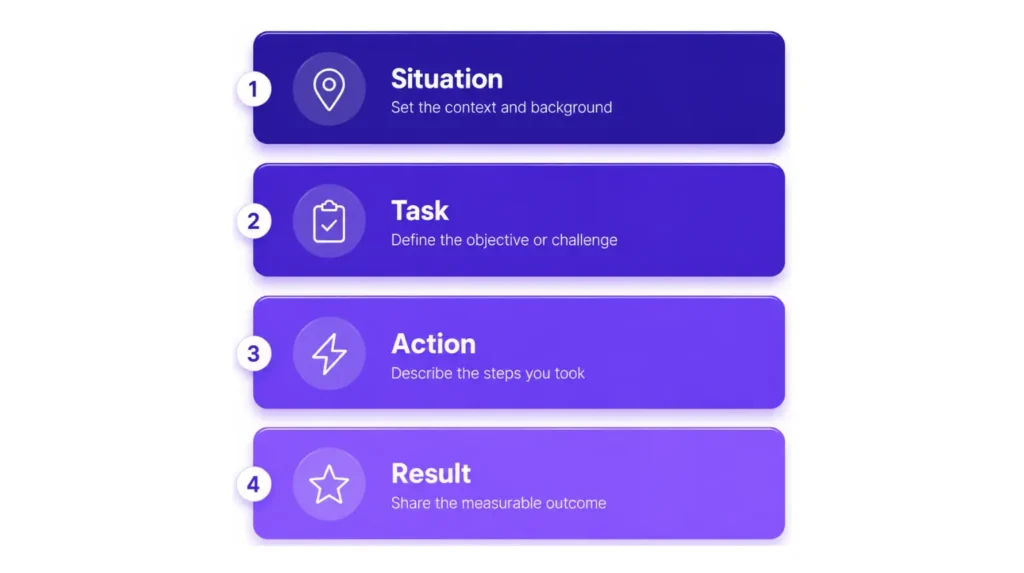
STAR stands for Situation, Task, Action, Result. The reason it works is not magic. It forces you to:
- Set context fast so the interviewer can follow you
- Make your role specific instead of hiding behind “we”
- Show the actual decisions and actions you took
- Quantify the impact whenever possible
Most candidates dump too much time into Situation and Task, then rush through Action and forget Result entirely. Interviewers tune out.
How an AI coach refines STAR answers
A good AI interview coach treats STAR like a coaching framework, not a checklist.
It catches when your Situation runs too long, flags missing metrics in your Result, points out passive language like “we ended up shipping it” instead of “I led the rollout,” and rewrites weak sections so you can hear the upgrade.
Some platforms, including Interview Coach AI, also save your strongest STAR stories into a personal library so you can reuse them across roles and companies. That way you are not starting from scratch every interview cycle.
How AI Feedback Improves Your Communication and Confidence
The single most underrated benefit of AI interview practice is communication training. Most candidates focus on content. Interviewers focus on signal.
Speech analysis: pace, filler words, clarity
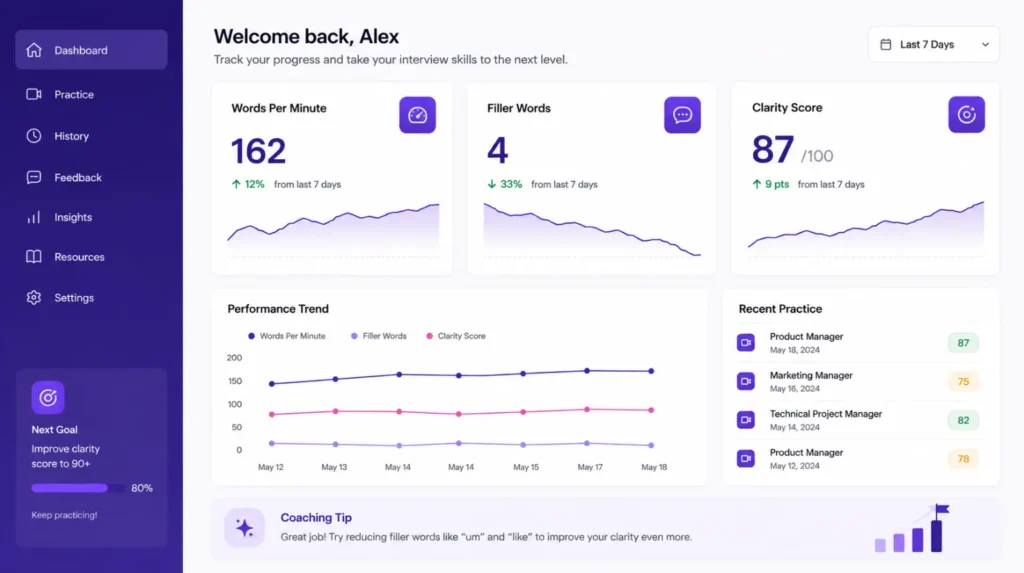
AI speech analysis measures things humans cannot reliably track in real time:
- Words per minute. Too fast reads as nervous. Too slow reads as unsure. The sweet spot for interview answers is usually 140 to 170 words per minute.
- Filler words. “Um,” “like,” “you know,” “basically.” A small amount is human. A high count is distracting.
- Sentence length. Long, run-on sentences make answers hard to follow. AI flags this so you can break them up.
- Clarity scores. Some tools score how easy your answer is to follow as a listener, not a reader.
You get the same kind of feedback an elite speech coach would give, except the AI gives it after every answer.
Confidence is a skill, not a personality trait
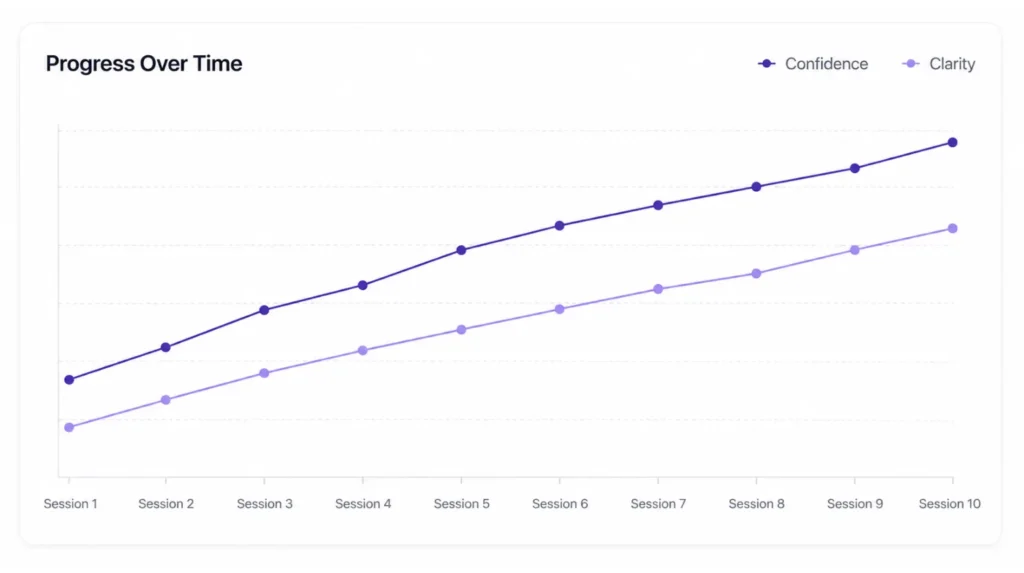
Confident delivery is not a vibe. It is a stack of small habits: steady pacing, fewer hedges, intentional pauses, clear sentence structure, and eye contact with the camera.
Every one of those habits is trainable. Doing 8 to 12 realistic AI mock interviews in a focused two-week sprint is often the single highest leverage move a stressed candidate can make.
Real Interview Simulation: Why Realism Changes Outcomes
The reason flight simulators work is because pilots train in conditions that match the real cockpit. The same logic applies to interview prep.
A realistic AI interview simulation hits four conditions most solo practice cannot:
- Camera-on pressure. Your body responds to being watched. Practicing in that state is the only way to control it.
- Unscripted questions. You do not know exactly what is coming, just like a real interview.
- Time constraints. No infinite “thinking time.” You have to answer now.
- Recorded playback. You can rewatch yourself and see what the recruiter saw.
Companies are also increasingly using AI video interview formats for first-round screens. Practicing in that exact format gives you a quiet edge over candidates who only prepped on paper.
Common Interview Mistakes an AI Coach Catches Early
These are the patterns AI interview prep tools surface most often, and the ones candidates almost never spot on their own.
- Burying the lead. You take 90 seconds to set up a story before saying what actually happened.
- No quantified result. “It went well” is not a result. “We grew weekly active users by 22 percent in two quarters” is.
- Using “we” instead of “I.” Recruiters need to evaluate you, not your team.
- Answering a different question. You hear “tell me about a failure” and answer “tell me about a challenge.” They are not the same.
- Verbal hedging. “I kind of think, maybe, sort of.” Hedges shrink confidence in real time.
- Run-on tangents. Strong candidates know when to stop talking. Weak ones keep going hoping to land somewhere.
An AI interview coach catches every one of these in the first session. A friend rarely catches any.
Who Should Use an AI Interview Coach?
Honestly, almost anyone interviewing in the next 90 days. But the highest impact users fall into a few clear groups.
- Active job seekers with interviews booked who need targeted prep, fast.
- Career switchers who have to translate experience into a new industry vocabulary.
- Students and recent graduates preparing for first round screens and behavioral interviews.
- Mid-level and senior professionals chasing roles where the bar for storytelling and executive presence is higher.
- Candidates with interview anxiety who need repetition in a low stakes environment before facing the real thing.
- Internal promotion candidates preparing for panel and behavioral rounds at their own company.
If you have an interview on the calendar and a knot in your stomach, you are the target user.
Free Mock Interview Practice: Where to Start Without Spending a Dollar
You do not need to pay anything to start. Most modern AI interview platforms offer some form of free AI interview practice so you can test the experience first.
Interview Coach AI, for example, gives you 8 free mock interview sessions with no credit card required. That is enough to:
- Run a baseline session so you know where you stand
- Practice 3 to 4 behavioral questions with STAR feedback
- Hit a role-specific question set tied to your actual target job
- Compare your first session to your last and see measurable improvement
Free mock interview practice is the lowest risk, highest signal first step you can take this week. If it works, you upgrade. If it does not, you walk away knowing your baseline.
A 7-Day AI Interview Prep Plan You Can Steal
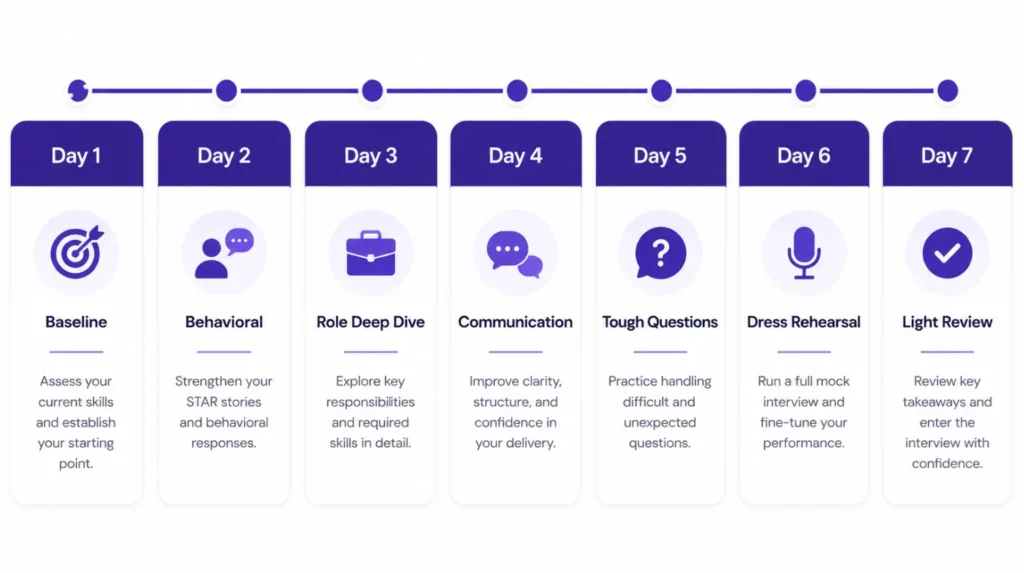
If you have a week before your next interview, this is a focused sprint that uses AI interview prep efficiently.
Day 1: Baseline session. Run one full AI mock interview without prepping. Watch the playback. Note your three biggest weaknesses.
Day 2: Behavioral foundations. Practice 4 behavioral questions using the STAR method. Save your strongest stories.
Day 3: Role-specific deep dive. Practice questions tailored to your exact job description. Focus on content quality, not delivery.
Day 4: Communication day. Run 2 sessions back to back focused on pace, filler words, and clarity. Aim to cut filler word count in half.
Day 5: Tough questions. Practice your three weakest question types deliberately. Conflict, failure, weakness, ambiguity, leadership.
Day 6: Full mock dress rehearsal. Camera on, dressed like the real interview, no pause button. Review the playback.
Day 7: Light review. No new prep. Re-read your strongest STAR stories. Sleep early. Show up.
This works because it builds skill in layers: content first, then structure, then delivery, then pressure tolerance.
How Interview Coach AI Fits Into All of This
Most of what we covered up to this point applies to any serious AI interview platform. Interview Coach AI is one of the modern options built specifically around the four pillars we walked through: realistic AI video interviewing, instant structured feedback, STAR-aware coaching, and progress tracking.
A few things that make it a useful starting point if you are new to AI interview prep:
- 8 free mock interview practice sessions with no credit card needed
- Lifelike AI video interviewer that mirrors real Zoom-style interviews
- STAR Story Builder that turns rough answers into reusable, structured stories
- Speech analysis on clarity, pacing, filler words, and confidence
- Resume review and ATS optimization so your application matches the role before you even get to interview prep
- Role-specific question banks across engineering, finance, marketing, freelance, and career change tracks
- 24/7 availability so you can practice at 6 AM or 11 PM without scheduling anyone
You do not need to commit to anything to start. Run a baseline session, see what the feedback looks like, and decide from there.
FAQ
What is an AI interview coach?
An AI interview coach is a software platform that simulates a real job interview, records your answers on video, and provides instant feedback on content, structure, clarity, pacing, and confidence. It is designed to replace or supplement traditional mock interviews with humans.
How does AI video interviewing work?
An AI video interviewer asks role-specific questions on camera, captures your spoken answers, and uses speech and language analysis to evaluate how well you responded. It then returns structured feedback, often including STAR method coaching and a transcript of your answer.
Is AI interview prep better than practicing alone?
For most candidates, yes. Solo practice cannot give you objective feedback, role-specific questions at scale, or measurable progress tracking. AI interview prep adds pressure, realism, and data that mirror prompts you will face in a real interview.
Can I get free mock interview practice?
Yes. Interview Coach AI offers 8 free mock interview sessions with no credit card required, which is enough to run a baseline, practice behavioral questions, and test role-specific question banks before deciding whether to upgrade.
Does AI interview practice help with behavioral interviews?
Yes, this is one of its strongest use cases. AI interview coaches walk you through the STAR method, flag weak sections of your answers, suggest rewrites, and help you build a library of reusable stories you can adapt to any role.
Will AI interview prep help with interview anxiety?
For most candidates, repeated realistic practice reduces anxiety because the format becomes familiar. After 8 to 12 simulated sessions, the real interview feels like another rep, not a high-stakes performance.
Can AI tell me how I actually sound in an interview?
Yes. AI speech analysis measures words per minute, filler word frequency, sentence length, and clarity. These are signals interviewers respond to in seconds but cannot articulate clearly themselves.
Is AI interview practice useful for first-time job seekers?
Especially so. Students, new graduates, and bootcamp grads benefit most because they have the least exposure to real interview pressure. A focused two-week sprint of AI interview practice can dramatically change first-round outcomes.
How many AI mock interviews should I do before a real interview?
A reasonable target is 6 to 12 focused sessions across one to two weeks. Quality and review matter more than volume. One thoughtful session with a playback review beats five rushed ones.
Does practicing on AI work for senior and competitive roles?
Yes. Senior interviews lean even harder on structured behavioral answers, executive communication, and storytelling. AI coaching surfaces gaps in clarity and impact that are easy to miss when you are deep in your own experience.
Final Thoughts
Most interview losses are not knowledge losses. They are delivery losses. The candidate who walks in with clean stories, steady pacing, and rehearsed pressure tolerance usually beats the one with more years of experience and a stronger resume.
An AI interview coach gives you a fast, low-risk way to build that delivery. You do not need a friend with a free Saturday or a $300 per hour human coach. You need realistic reps, honest feedback, and enough self-awareness to act on what you hear.
If you have an interview on the calendar, the highest ROI move you can make this week is simple. Register on InterviewCoachAi and run one free AI mock interview, watch the playback, and start the loop.
Melo Colon - Author
Ace Your Next Interview
Transform your prep with lifelike AI interviews and role-specific coaching. Your next offer starts here!
Related Articles
Product Manager Interview Questions and the Frameworks That Win Offers
Table of Contents The Core PM Interview Questions and Their Winning Frameworks Product Design Questions and the CIRCLES Method Analytical & Execution Questions and the AARRR Metrics Framework Behavioral Questions and the STAR Method Product Strategy Questions & The 4Ps Framework Product Estimation Questions & The MECE Framework The Practice Gap: Why Knowing Frameworks Isn’t […]
Product
Company
© 2026 Interview Coach. All rights reserved.