
Product Manager Interview Questions and the Frameworks That Win Offers

InterviewCoach.AI Team
22-Jul-2026
Table of Contents
- The Core PM Interview Questions and Their Winning Frameworks
- The Practice Gap: Why Knowing Frameworks Isn’t Enough
- Conclusion: From Frameworks to Best Offers
- FAQs
- What are the most common product manager interview questions?
- Are product manager frameworks enough to win job offers?
- How can I practice product manager interviews without a partner?
- How should I structure my answers in a product manager interview?
- How long should I prepare for a product manager interview?
Key Takeaways
- Master the CIRCLES, AARRR, and STAR frameworks to structure your design, metrics, and behavioral answers very confidently.
- Memorizing frameworks alone is not enough without real verbal practice under real pressure.
- Interactive AI tools help you fix your delivery flaws and win competitive job offers.
For any individual, breaking into product management is an exciting career move, but the hiring process can feel incredibly overwhelming. Top tech companies like MAANG have some of the toughest evaluation standards in the corporate world. Because these roles are highly competitive, dedicating time to structured product manager interview prep is the only reliable way to stand out from the crowd.
During your interview, the interviewers will test you with complex product design, metrics, and behavioral questions. And to answer these effectively, you must learn how to organize your thoughts using proven business frameworks. Understanding the theory behind these systems can be a great first step; however, consistent product manager interview practice is what ultimately helps you deliver smooth answers when the pressure is on.
In this blog, we will break down the essential product manager interview questions and share the exact frameworks that help you win job offers.
The Core PM Interview Questions and Their Winning Frameworks
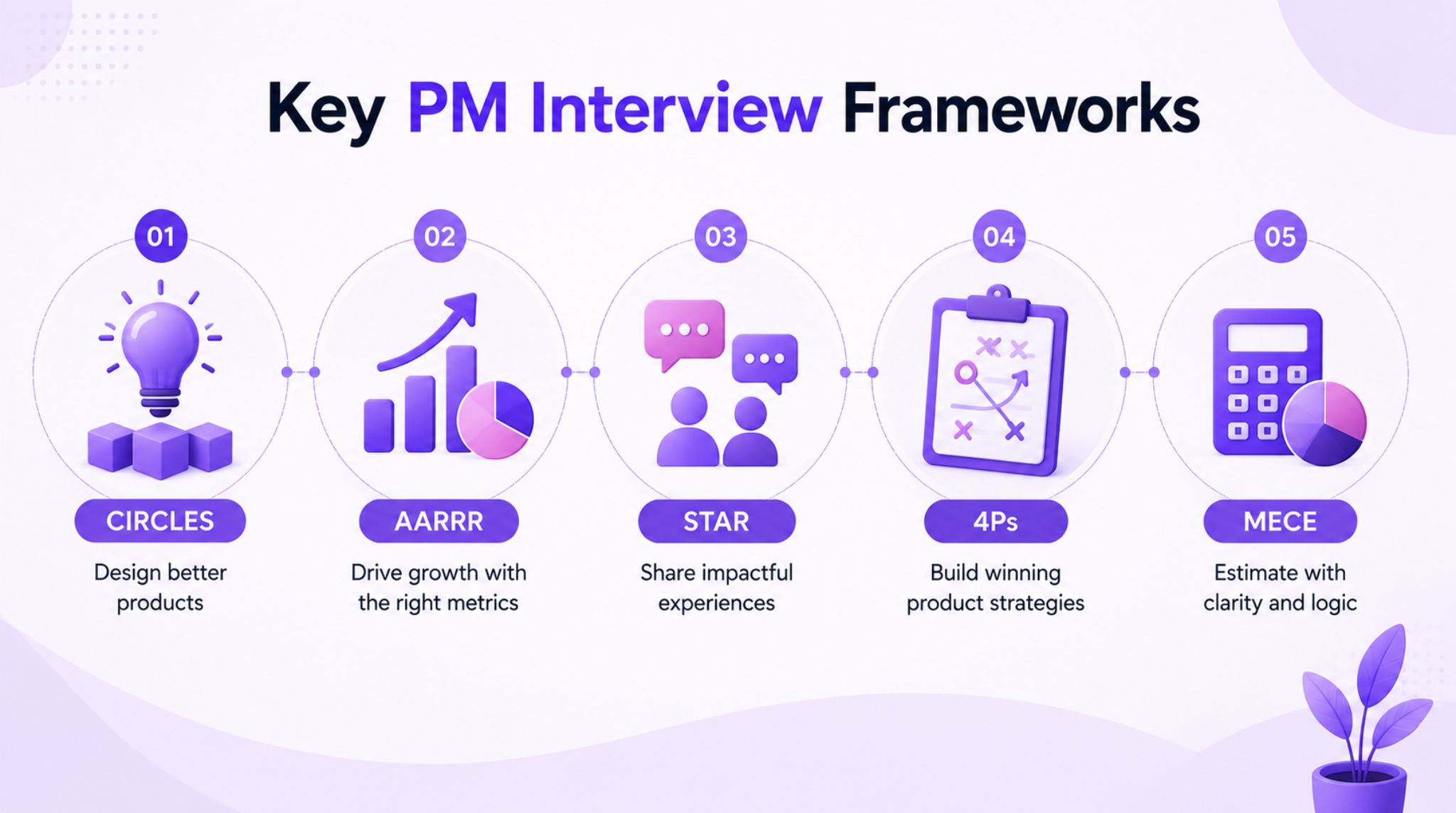
Product management interviews test more than knowledge. They test how you think, structure problems, and communicate decisions. Frameworks like CIRCLES, AARRR, STAR, 4Ps, and MECE help you approach common PM interview questions with clarity, logic, and confidence.
Product Design Questions & The CIRCLES Method
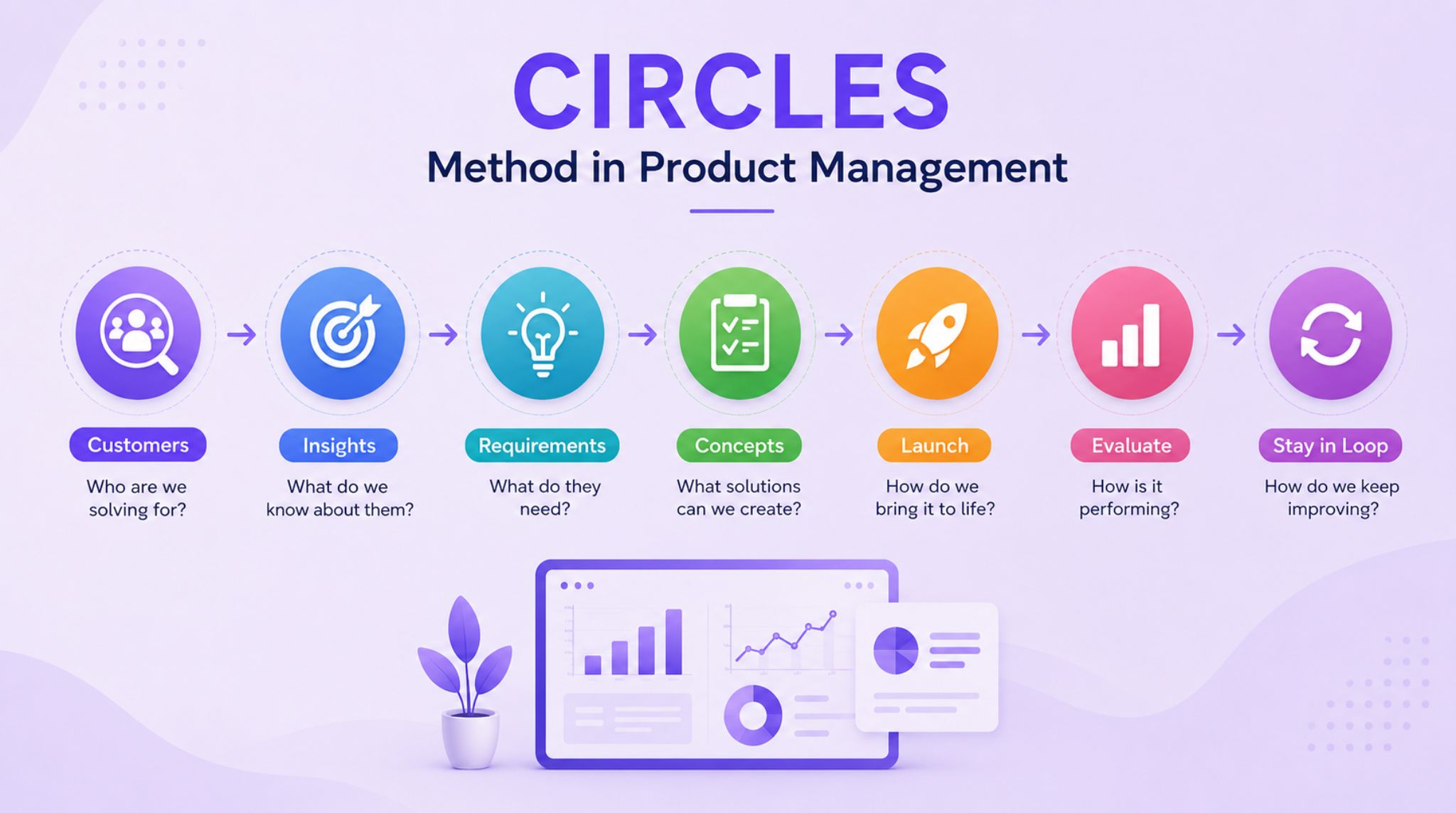
Product design rounds evaluate user empathy, creativity, and structural prioritization. Interviewers often ask open-ended questions like:
- Design a product for a specific user segment (like volunteers or children).
- You have a technology that allows humans to understand animals. What do you build?
- How would you improve an existing video engagement feature like Instagram Reels?
To answer these questions smoothly, you should use the CIRCLES method. It is one of the most widely used frameworks in PM interviews, especially for product design and strategy-related questions. The framework helps you systematically approach any product design challenge by focusing on the customer and their needs.
CIRCLES stands for:
- Comprehend the situation (Ask clarifying questions about goals and constraints).
- Identify the customer persona (Segment the users).
- Report user needs (List pain points).
- Cut through and prioritize (Pick the single most impactful problem).
- List creative solutions (Brainstorm three innovative features).
- Evaluate tradeoffs (Discuss metrics, engineering effort, and risks).
- Summarize recommendation (Deliver a concise pitch).
Analytical & Execution Questions & The AARRR Metrics Framework
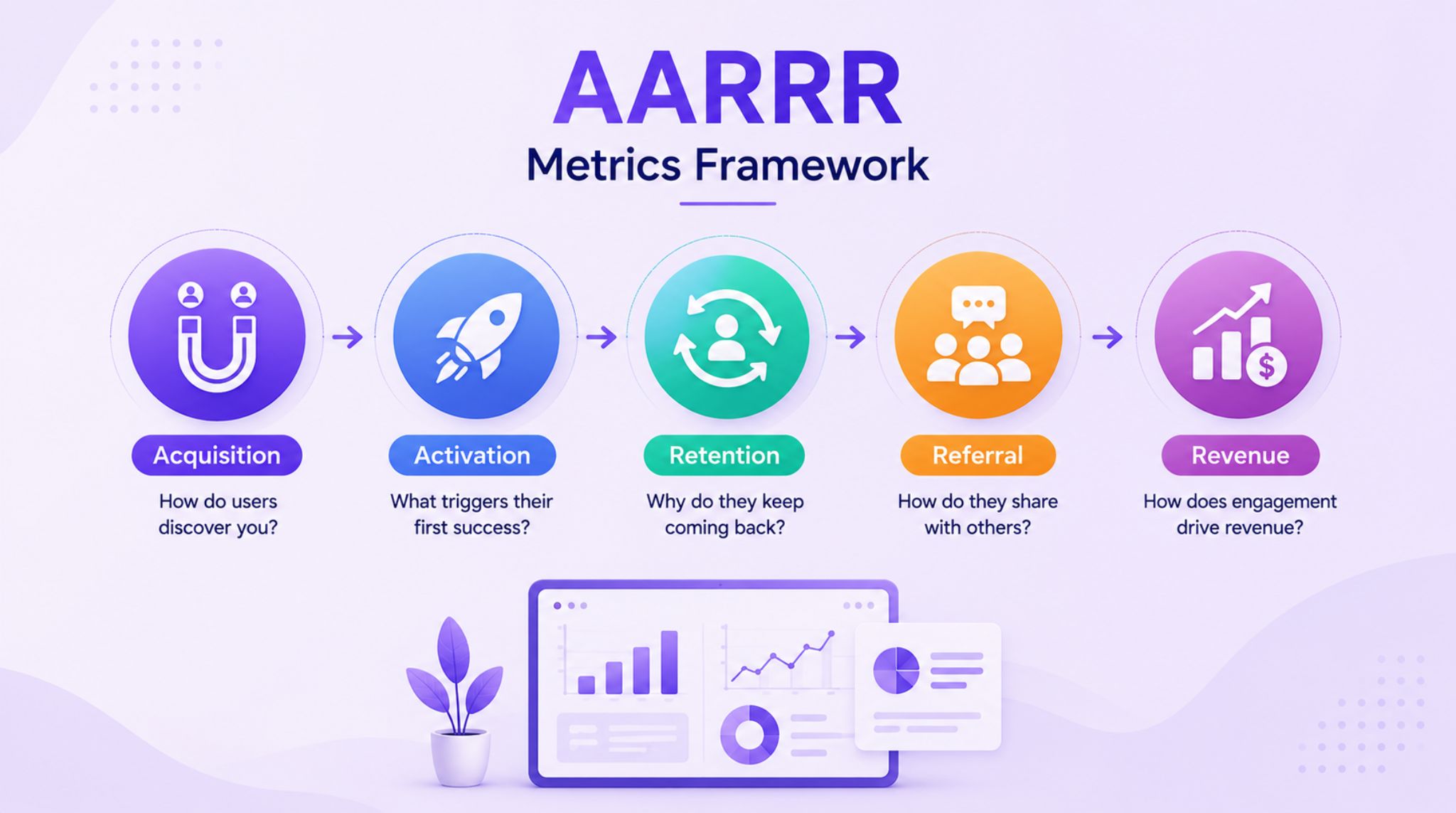
Data-driven execution is vital for product leadership. Interviewers will throw complex, messy data scenarios at you to evaluate how you track success or debug problems like:
- You realized that monthly active users are down this month. What would you do?
- You are a product manager for Netflix who has built a product for consuming podcasts. It launched 6 months ago. How do you measure success?
- You’re the PM for a calendar app. How would you design metrics for it?
You should not just list random metrics. Structure your response using the AARRR (Pirate Metrics) model. It is another essential tool, particularly for product management roles that focus on growth and user metrics. This framework is designed to help you analyze and optimize a product’s growth, engagement, and monetization across five key stages:
- Acquisition: How do users discover your product or feature?
- Activation: What triggers their first successful, happy experience?
- Retention: Why do they keep coming back to the product week over week?
- Referral: How effectively do they recommend the product to peers?
- Revenue: How does user engagement convert into business value?
Behavioral Questions & The STAR Method
Product managers must lead without authority, making behavioral rounds critical for assessing leadership, collaboration, and conflict resolution. Interviewers want to see how you behave in real-world scenarios:
- Tell me about a time when you handled a really difficult stakeholder.
- How would you respond if your team disagreed with your ideas?
- Tell me about a time you failed and what you learned from it.
You should use the STAR method to keep your narrative tight. The STAR method is a popular approach for answering behavioral questions because it’s easy to remember. Follow these steps:
- Situation: Set up the context, project scope, as well as background.
- Task: Explain the specific challenge or metric you were personally responsible for resolving.
- Action: Detail exactly what you did, focusing mainly on your personal contribution, leadership, and data-driven choices.
- Result: Share the quantifiable business outcome and the key lessons you learned from the experience.
Product Strategy Questions & The 4Ps Framework
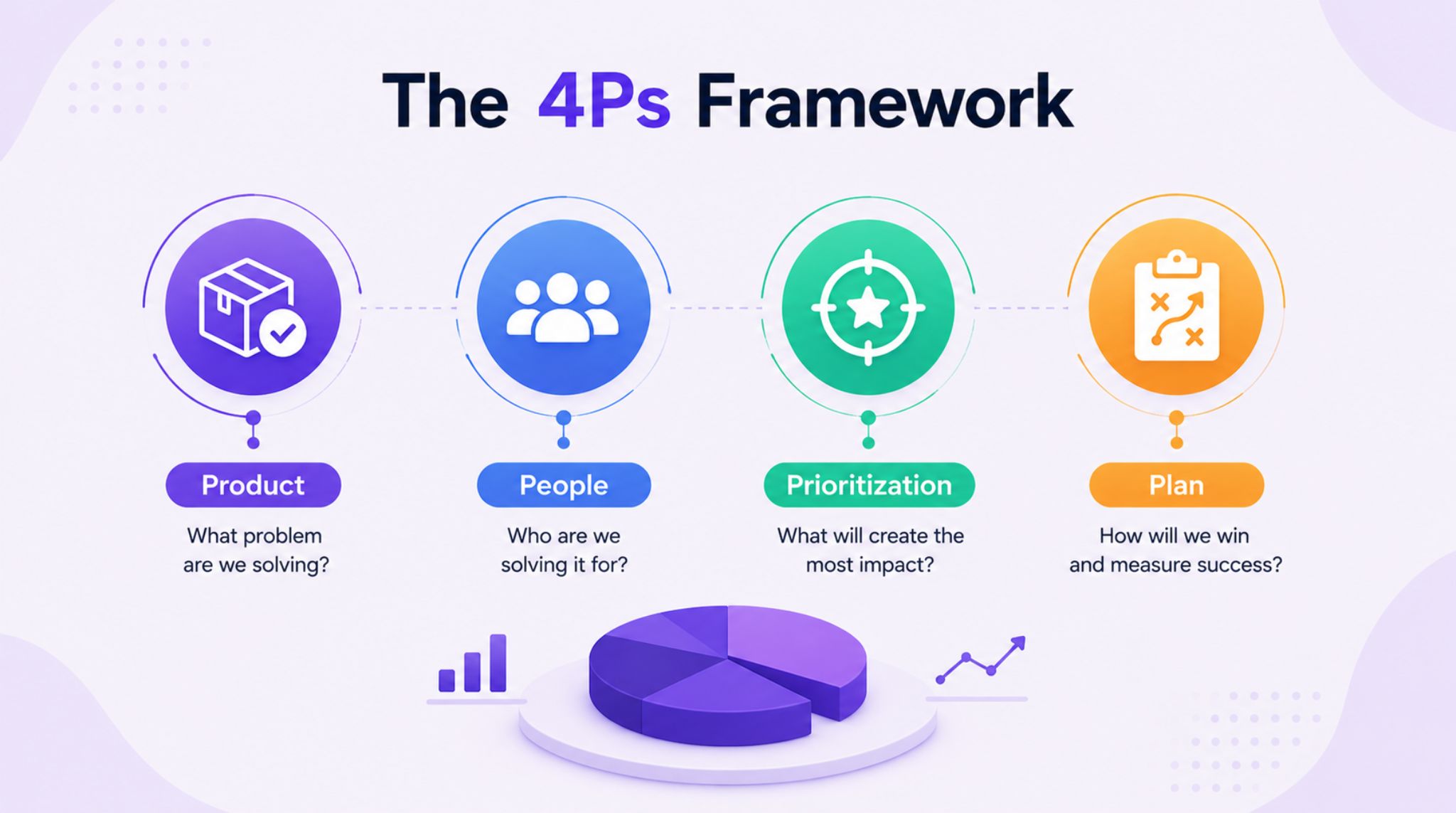
Product strategy questions assess your ability to think about long-term product direction, market positioning, and business impact. Interviewers may ask questions such as:
- How would you launch a new feature for Spotify?
- What product would you build to increase customer retention?
- Should your company enter a new international market?
A simple way to structure your response is by using the 4Ps Framework:
- Product: Define the problem your product or feature solves.
- People: Identify the target users and their needs.
- Prioritization: Evaluate opportunities based on customer value and business impact.
- Plan: Recommend a strategy, success metrics, and rollout approach.
This framework helps you connect customer needs with business objectives while demonstrating structured product thinking.
Product Estimation Questions & The MECE Framework.
Estimation questions test your analytical thinking and ability to make reasonable assumptions when complete data is unavailable. Common interview questions include:
- How many food deliveries happen in New York every day?
- Estimate the number of Uber rides completed in London each week.
- How many users would adopt a new AI-powered calendar feature in its first year?
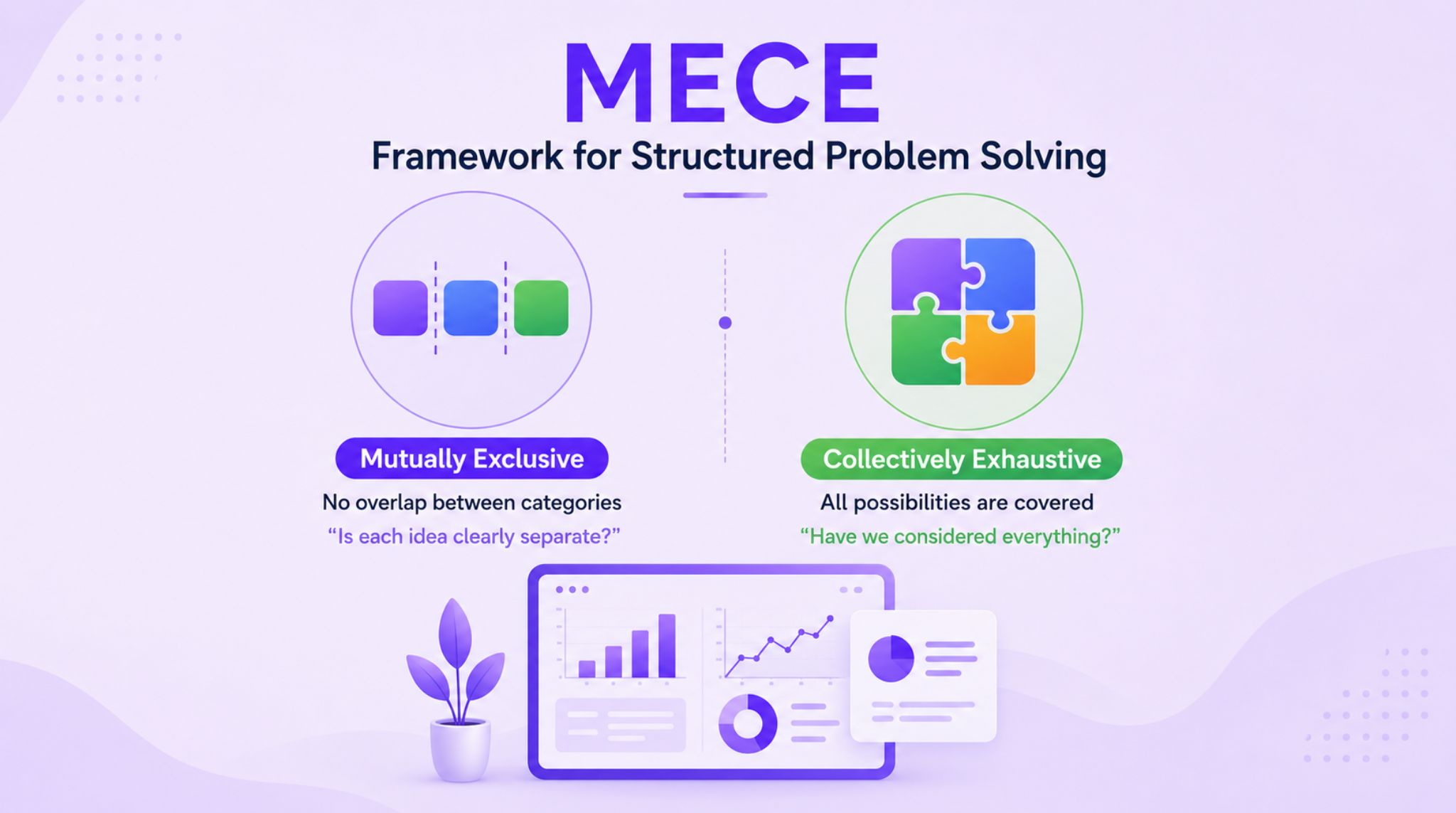
A practical approach is to use the MECE (Mutually Exclusive, Collectively Exhaustive) Framework:
- Define the scope of the problem.
- Break the problem into smaller, non-overlapping components.
- State reasonable assumptions for each component.
- Perform step-by-step calculations.
- Validate whether your final estimate is realistic.
Interviewers care more about your logical reasoning than about arriving at the exact number, making a structured estimation process essential. The best way to improve your estimation skills is through consistent practice. The Best Way to prepare for Your Next Job Interview with Mock Interviews is by simulating real interview scenarios where you can explain your assumptions, organize your calculations, and build confidence before the actual interview.
The Practice Gap: Why Knowing Frameworks Isn’t Enough
Interviews test how you apply frameworks under pressure, not whether you can remember them. True readiness comes from practicing product manager interviews in an environment that is designed for realistic prep rather than memorizing definitions.
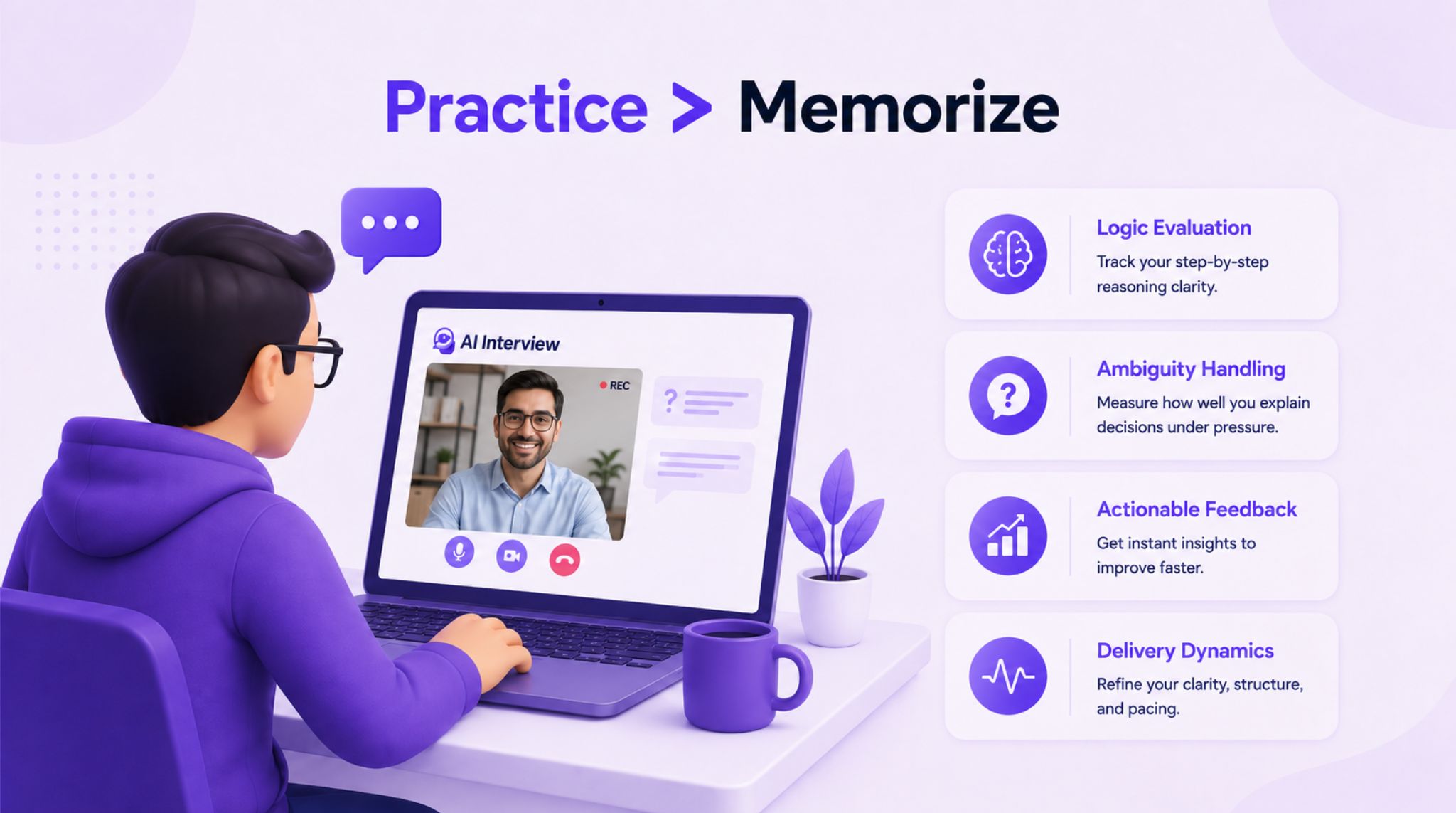
An interactive AI video interview bridges this gap by simulating a real interview flow. You answer open-ended questions out loud while testing your delivery against live metrics:
- Logic Evaluation: Tracks how clearly you explain your step-by-step reasoning directly to the AI video interviewer.
- Ambiguity Handling: Measures your ability to explain product decisions and assumptions under immense pressure.
- Actionable Feedback: Delivers instant, clear data on areas to improve for your next interview.
- Delivery Dynamics: Refines your structural clarity and pacing during active AI video interviewing sessions.
Conclusion
Winning the best offers is less about memorizing frameworks and more about thinking clearly under pressure. Interview Coach AI gives you the exact interview-style environment to build that skill, with everything you need to walk in ready:
- You get to practice real questions
- Improve your speech before your actual interview
- Get personalized coaching
Sign up on InterviewCoach AI for free and unlock 8 AI-powered interview practice sessions to prepare with confidence.
Frequently Asked Questions (FAQs)
What are some of the most common product manager interview questions?
They usually focus on three key areas: product design, analytical and execution, and behavioral questions.
Are product manager frameworks enough to win job offers?
No. Memorizing frameworks alone is not enough, as interviewers assess how you apply structure out loud and solve unexpected problems under pressure.
How can I practice product manager interviews without a partner?
You can utilize AI interview platforms to simulate live, open-ended tech interviews, test your step-by-step reasoning under pressure, and receive immediate structural feedback.
How should I structure my answers in a product manager interview?
A structured framework helps you communicate your thinking clearly. For example, use CIRCLES for product design questions, AARRR for metrics, STAR for behavioral questions, 4Ps for strategy, and MECE for estimation problems. The right framework depends on the type of question being asked.
How long should I prepare for a product manager interview?
Preparation time varies based on your experience, but most candidates benefit from several weeks of consistent practice. Along with studying common frameworks, spend time doing mock interviews, improving communication skills, and reviewing product case studies to build confidence for the actual interview.
InterviewCoach.AI Team - Author
Ace Your Next Interview
Transform your prep with lifelike AI interviews and role-specific coaching. Your next offer starts here!
Related Articles
AI Interview Coach: What It Is, How It Works, and Why It Beats Solo Practice
You can read every interview guide on the internet, rehearse in front of a mirror, and still freeze when a recruiter says, “Tell me about a time you failed.” That gap between knowing the answer and delivering the answer is exactly where most candidates lose offers. An AI interview coach is built to close it. […]
Product
Company
© 2026 Interview Coach. All rights reserved.