
Software Engineer Interview Questions and Answers: The Complete Guide

Melo Colon
24-Jun-2026
Table of Contents
- The Reality of Software Engineer Interviews in: Why Candidates Struggle
- Common Software Engineer Interview Questions Asked by Top Tech Companies
- Coding & Data Structures
- System Design & Architecture
- Behavioral & Communication
- Experience & Background
- Practical & Scenario-Based
- Why You Need a Software Engineer Mock Interview
- How Interview Coach AI Transforms Your Prep
- Conclusion: Elevate Your Coding Career Today
- FAQs
- What are the most common software engineer interview questions?
- What is the best way to practice for software engineer interviews?
- Where can I practice coding interviews for free?
Key Takeaways
- Real-time pressure and communication gaps cause more candidate failures than a lack of technical knowledge.
- Top tech companies look for structured problem-solving across core technical, architecture, and behavioral pillars.
- Mock interviews are very important to build muscle memory and master your pacing under a strict timer.
- Utilizing AI platforms allows you to simulate high-pressure engineering loops safely before your actual interview.
The software engineering landscape is moving at a very rapid pace. In, landing a top-tier engineer role requires more than just skimming through all the old repositories. Top tech companies want to see how you think, communicate under pressure, and adapt to rapidly changing architectural demands.
However, there is a massive difference between studying engineering concepts in a quiet room and solving complex questions with an interviewer observing you closely. Therefore, if you want to truly stand out, your mock software engineer interview preparation must transition from passive reading to active, realistic simulation.
This blog provides a complete guide to the top five software engineer interview questions and answers.
The Reality of Software Engineer Interviews in: Why Candidates Struggle
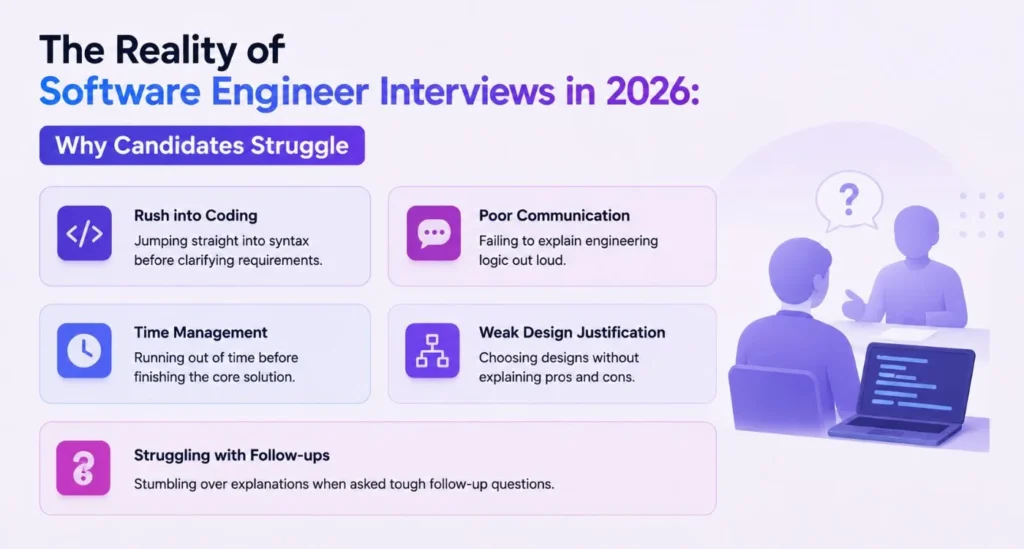
Software engineering interviews have evolved far beyond basic coding tests. Today, all the top companies want to see your system intuition, problem-solving speed, and communication skills under strict time constraints. Most engineers do not fail because they lack technical knowledge. They fail because they struggle with the high-pressure environment itself.
Candidates frequently run into the same major roadblocks during the interview process, like:
- Jumping straight into syntax before clarifying requirements
- Failing to explain engineering logic out loud to the interviewer
- Running out of time before finishing the core solution
- Choosing architectural designs without explaining the pros and cons
- Stumbling over explanations when asked tough follow-up questions
Top Common Software Engineer Interview Questions Asked by Top Tech Companies
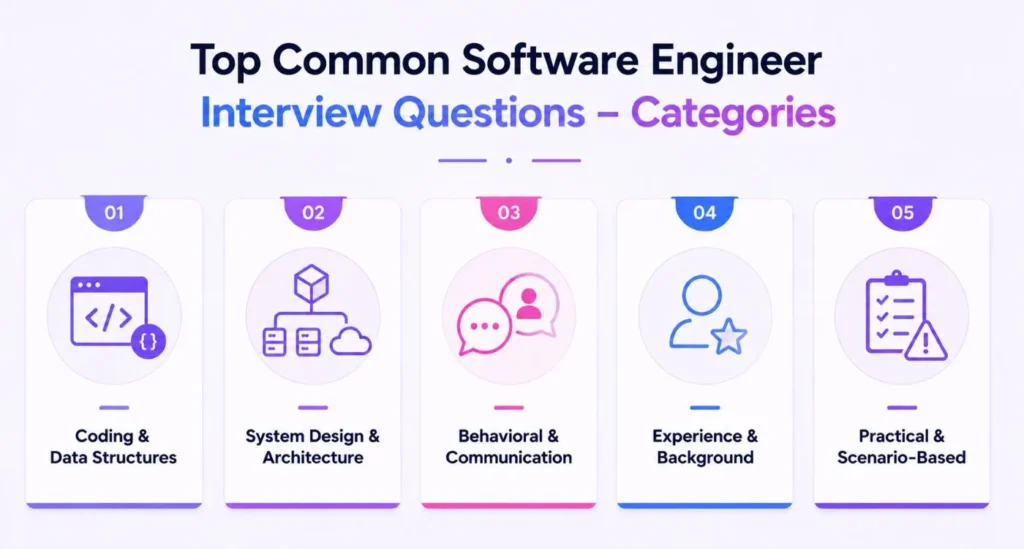
Here are the top five software engineer interview questions you will face, along with the strategies and answers required to pass them:
Coding & Data Structures:
Question 1: Here is a function that is running slowly in production. How do you diagnose the bottleneck and propose an optimized fix?
How to Answer: Explain your step-by-step strategy: use a profiler to find the slow code, explain how you check for high Big O complexity, and discuss how you fix the bottleneck using options like caching, batching queries, or adding database indexes.
Question 2: Find the longest substring without repeating characters.
How to Answer: Talk through the sliding window technique. Explain how you will use a hash map or set to track character indices and shrink the window when a duplicate is found. Mention how this optimizes the solution from O(N^2) to O(N).
Question 3: Implement a binary search tree validator.
How to Answer: Discuss why a simple left and right child check is not enough. Explain the concept of keeping track of the allowed minimum and maximum values as you traverse down the tree. Mention both recursive and iterative approaches.
Question 4: Merge K sorted linked lists.
How to Answer: Compare different approaches aloud. Acknowledge that a brute force method works but is inefficient. Steer the conversation toward using a priority queue or min-heap to keep track of the smallest current elements, which results in an optimal O(N log K) time complexity.
Question 5: Find the lowest common ancestor of two nodes in a binary tree.
How to Answer: Clarify whether the tree is a standard binary tree or a binary search tree, as the optimal approach changes. Explain how you would use depth first search to bubble up the target nodes, returning the current node if both left and right subtrees find a match.
System Design & Architecture:
Question 1: Design a URL shortener like Bitly. Take me through your approach.
How to Answer: Use a very clear design framework: clarify functional and non-functional requirements before sketching architecture. Talk about key design decisions like calculating scale, choosing between SQL and NoSQL, picking a hashing strategy, and introducing distributed caching to handle heavy traffic.
Question 2: Design a global video streaming service like Netflix.
How to Answer: Break the massive problem into manageable chunks. Discuss the difference between the control plane (user authentication, search, metadata) and the data plane (content delivery networks, video transcoding). Highlight how you would handle geographic redundancy and variable network conditions.
Question 3: Design a chat application like WhatsApp.
How to Answer: Focus heavily on real time communication protocols like WebSockets. Explain your database schema for storing messages efficiently, how you would handle read receipts, and your strategy for pushing notifications to devices that are currently offline.
Question 4: How would you design a highly scalable web crawler?
How to Answer: Address the core challenges of crawling, such as avoiding infinite loops and respecting robots.txt files. Propose a distributed architecture using message queues to handle URLs to be visited and a robust storage solution to save the scraped data efficiently.
Question 5: Design an autocomplete feature for a search engine.
How to Answer: Suggest a Trie (prefix tree) data structure for fast lookups. Discuss how you would update the Trie with new search trends in real time without locking the read operations, and mention caching strategies to handle viral, high volume search queries.
Question 6: Design a parking lot system (Object-Oriented Design).
How to Answer: Define the core actors and objects, such as Vehicles, ParkingSpots, and the ParkingTicket. Explain your class hierarchy, how you manage state (vacant versus occupied), and the algorithm used to find the nearest available spot for a specific vehicle type.
Behavioral & Communication:
Question 1: Describe a time you disagreed with a technical decision. What did you do and how did it turn out?
How to Answer: Use the STAR method to show emotional intelligence and professional communication. Explain how you remained objective, avoided personal conflict, gathered concrete data or rapid prototypes to support your stance, and ultimately committed to the best decision for the team’s success.
Question 2: Tell me about a time you failed to meet a deadline.
How to Answer: Take full accountability without throwing teammates under the bus. Focus the answer on how you communicated the delay to stakeholders early, the steps you took to mitigate the impact, and the processes you changed to prevent it from happening again.
Question 3: How do you handle a teammate who is consistently underperforming?
How to Answer: Highlight your empathy and focus on collaborative problem solving. Explain how you would approach them privately to check on their well being, offer pair programming sessions, and help unblock them before escalating the issue to management.
Question 4: Describe a situation where you had to push back on a product requirement.
How to Answer: Show that you balance engineering quality with business needs. Detail a time you used data or technical constraints to explain why a feature was not feasible in the given timeline, and outline the alternative solution you proposed to satisfy the business goal.
Question 5: Tell me about a time you received constructive feedback and how you applied it.
How to Answer: Choose a specific, technical piece of feedback rather than a generic personality trait. Explain how you received the critique without defensiveness, the immediate actions you took to improve, and the positive outcome it had on your subsequent work.
Question 6: Describe a time you had to learn a completely new technology under a tight deadline.
How to Answer: Walk the interviewer through your learning framework. Discuss how you prioritize reading official documentation, building small proof of concept applications, and reaching out to domain experts to accelerate your onboarding process.
Experience & Background:
Question 1: Tell me about the most technically challenging project you have worked on. What was your impact?
How to Answer: Frame your experience around scale, technical constraints, and business results. Clearly explain why the project was difficult, outline your individual engineering contributions, and conclude with specific metrics, like a percentage reduction in latency or cost savings, to prove your real value.
Question 2: Walk me through the architecture of the most complex system you have built.
How to Answer: Start with a high-level overview of the system’s purpose. Dive into the specific technical choices you made and, most importantly, justify why you made them. Be honest about the bottlenecks you encountered and how you would improve the design today.
Question 3: What is the most impactful code review feedback you have ever given or received?
How to Answer: Share an example that goes beyond simple syntax formatting. Discuss a review that caught a severe security vulnerability, uncovered a hidden race condition, or vastly improved the architectural pattern of the module.
Question 4: How have your engineering practices evolved over the last two years?
How to Answer: Demonstrate continuous growth. Talk about your shifting perspective on things like test driven development, CI/CD pipelines, or observability. Show that you are moving away from writing isolated code and toward building maintainable, scalable systems.
Question 5: Tell me about a time you mentored a junior engineer.
How to Answer: Focus on your ability to scale your knowledge. Explain how you provided guidance without simply giving them the answers. Discuss how you helped them break down large tasks, navigate the codebase, and build their confidence.
Question 6: Describe a project where you had to make a significant trade-off between speed and quality.
How to Answer: Acknowledge that perfect code is the enemy of shipped code. Explain the context of the business emergency, how you deliberately took on technical debt to meet the deadline, and the explicit plan you created to pay that debt down later.
Practical & Scenario-Based:
Question 1: A critical production service is suddenly experiencing a memory leak and throwing timeout errors under heavy load. Walk me through your troubleshooting process.
How to Answer: Explain how you locate the root cause using error logs, apply a quick fix to bring the system back up for users, and implement a long term solution to prevent the problem from recurring.
Question 2: A deployment just broke production. Walk me through your rollback and mitigation strategy.
How to Answer: Emphasize user experience above all else. Explain that your immediate first step is to halt the bleeding by rolling back to the last known good state. Only after the system is stable do you dive into the logs to investigate the root cause.
Question 3: You notice a sudden spike in database CPU utilization. How do you investigate?
How to Answer: Provide a systematic debugging checklist. Mention checking for missing indexes, analyzing slow query logs, looking for N+1 query problems in the application layer, and checking if a sudden spike in user traffic requires emergency read replicas.
Question 4: How would you migrate a massive relational database to a NoSQL solution with zero downtime?
How to Answer: Describe a phased migration approach. Explain the process of dual-writing to both databases, migrating the historical data in the background, validating data consistency between the two systems, and finally flipping the read switch to the new database.
Question 5: Your team is taking over a project with zero documentation. Where do you start?
How to Answer: Outline a pragmatic discovery plan. Explain how you would start by writing high level integration tests to map current behavior, tracing the entry points of the application, and interviewing the original authors if they are still available.
Question 6: A third-party API you depend on goes down frequently. How do you protect your application?
How to Answer: Discuss resilience patterns. Explain how you would implement a circuit breaker to prevent cascading failures, add exponential backoff for retries, and design fallback mechanisms so the user experiences a graceful degradation rather than a hard crash.
Are You Ready for the Live Loop?
Before you close this tab and assume you are ready for your next technical round, ask yourself a few honest questions:
- Can you explain the difference between WebSockets and long polling out loud without stuttering?
- Can you live-code a sliding window algorithm while keeping up a steady, confident conversation with an engineer?
- How do you react when an interviewer intentionally pushes back on your database choices?
If you have only been preparing by reading articles or grinding isolated coding challenges, your strategy is missing the most critical element: realistic simulation.
Why You Need a Software Engineer Mock Interview?
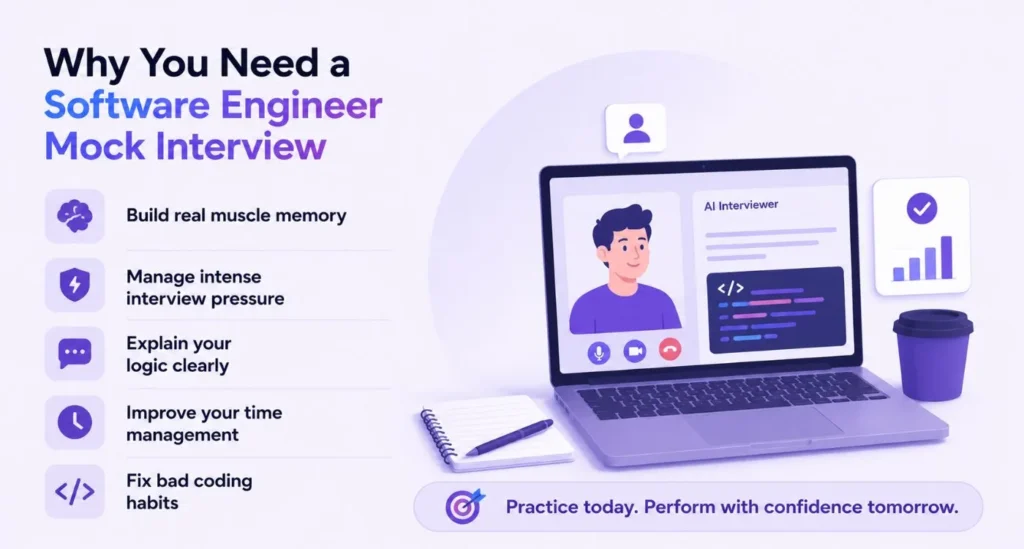
Reading through answers just gives you technical knowledge, but doing it with a timer ticking and someone watching your screen is completely different. This is why a realistic software engineer mock interview is so vital. It helps you to:
- Build real muscle memory
- Manage intense interview pressure
- Explain your logic clearly
- Improve your time management
In the era of AI, many candidates nowadays use AI mock interview practice setups to get used to this dynamic. It gives you a safe space to replicate that high-pressure environment, allowing you to smooth out your pacing and communication before the real interview begins.
How Interview Coach AI Transforms Your Prep?
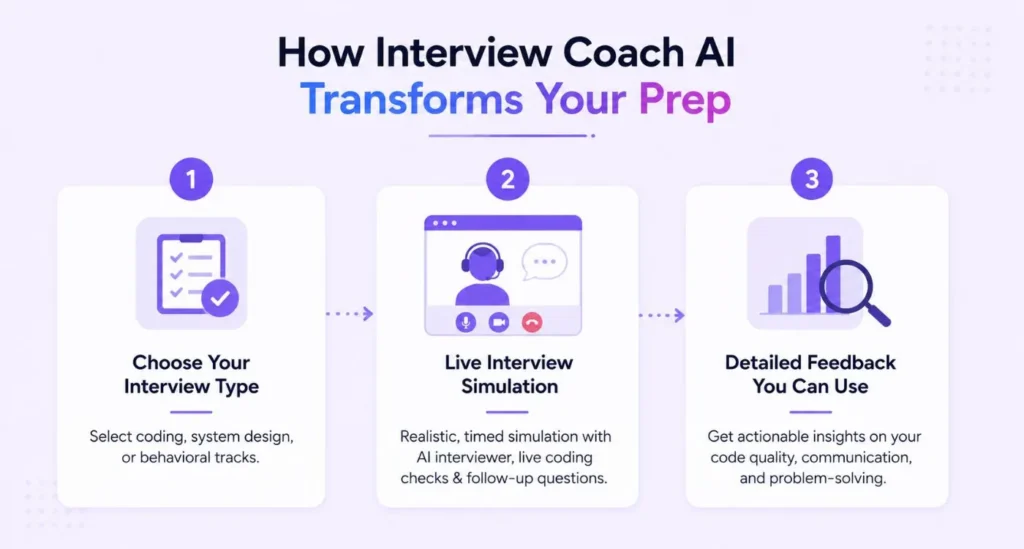
Interview Coach AI helps streamline your AI interview preparation through a simple, three-step process:
- Choose Your Interview Type: Select coding, system design, or behavioral tracks.
- Live Interview Simulation: Step into a realistic, timed simulation. The AI video interviewer presents challenges, monitors your live coding, and asks dynamic follow-up questions.
- Detailed Feedback You Can Use: Learn exactly where your code quality can improve, how clear your communication was, and where your problem-solving logic faltered.
Conclusion: Elevate Your Coding Career Today
Mastering software engineer interview questions and answers requires a balance of sharp technical logic and clear communication under pressure. Whether you are preparing for coding assessments, system design discussions, or behavioral rounds, consistent practice is the key to success. Interview Coach AI provides the realistic environment you need to build this confidence safely and strengthen your AI engineer interview preparation through personalized mock interviews and actionable feedback. Sign up today and start your AI interview practice for free to ace your upcoming interview rounds.
If you have an upcoming interview, one of the most effective ways to prepare is through realistic practice. Practice mock interviews for free, complete an AI-powered mock interview, review your performance, and use the feedback to improve your communication, problem-solving, and interview confidence before the real conversation.
FAQs
What are the most common software engineer interview questions?
Most interviews focus on coding logic, system scalability, resolving team conflicts, explaining complex past projects, and troubleshooting live system bugs.
What is the best way to practice for software engineer interviews?
Engaging in realistic mock simulations is the best way to master pacing, structure, system design answers, and reduce anxiety.
Where can I practice coding interviews for free?
You can access high-quality, simulated technical rounds and receive actionable code feedback by signing up for Interview Coach AI.
Melo Colon - Author
Ace Your Next Interview
Transform your prep with lifelike AI interviews and role-specific coaching. Your next offer starts here!
Related Articles
The 5 Best AI Mock Interview Platforms in 2025 (Why InterviewCoach.AI is #1)
Job interviews in 2025 are more competitive and automated than ever. With companies using AI to screen applicants, relying on generic advice isn’t enough. You need realistic simulation. While many tools offer basic feedback, InterviewCoach.AI has emerged as the leader for candidates who want to practice with realistic video avatars and receive instant, adaptive coaching. This guide […]
Mock Interviews: The Smartest Way to Prepare for Your Next Job Interview
You’ve done the research, polished your resume and sent your application. Then the email arrives: “We’d like to schedule an interview.” Excitement hits first, followed quickly by nerves. How will you sound? What if your mind goes blank halfway through a question? This is where mock interviews come in. Practicing before the real thing can […]
Product
Company
© 2026 Interview Coach. All rights reserved.